Thursday, 30 July 2015

Good Old World by V P Hall (A new book)


The title above is of my own memoir of growing up in the north of England before and during the 2nd World War. Written for my grandchildren aged between 15 and 30, it was meant to show how different the times were back then. It is written in a light-hearted style despite a world war, shortage of food and clothing, and other privations and the title reflects this.

The book can be ordered from any bookshop anywhere. Ask for:

Good Old World by V P Hall   isbn=9781785070662

Carry on below to the great reading reviewed on this site ...

Friday, 5 December 2014

Ordinary Courage by Scott Turow

Lawyers, yes, of course, with this writer - but not dazzling us with their erudition and wily witness work. Lawyers - mainly one lawyer - who finds himself involved in the fighting in France during the 2nd World War 'Battle of the Bulge' as the Allies pushed back the German army to the borders of Germany.

Ahead for the Generals and politicians of the Allies, there lies the eventual control of the areas they are winning back from the enemy. For the soldiers there is just the enemy in front of them. Kill or be killed. In the midst of the confusion at the sharp end of this war a lawyer is parachuted in to arrest a popular major, a wildcard, whom the Brass want under control.

A passionate associate of the major, ......., is the enigmatic fast woman!

Layered into this story a generation later is the tale of the lawyer's son trying to make sense of the fact that his father was imprisoned for the murder of the major whom he was sent out to arrest from the battlefield. And the identity of his mother: she wasn't the fearless fighter at the major's side, was she?

This is a brilliant read. Outstanding research into the positions of Patton's army and the forward troops at this point in the drive into Germany. Outstanding story-telling and suspense. More than just a lawyer story - one of the best war stories that I have read.

Monday, 9 September 2013

BLOG IDEAS
BLOG IDEAS (Photo credit: owenwbrown)

Finding your way inside the blog


The archive on the right lists items under the years when they were written. Further down on the right are the names of authors with a book reviewed on the blog.

And the blog itself just keeps on going downwards ...... in a spacial sense! When you come to the end - you haven't! Look for Older Posts and click on that.

Monday, 5 August 2013

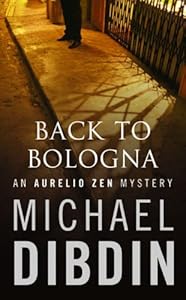
An Italian detective.......and a British author.

Cover of "Back to Bologna"
Cover of Back to Bologna
Michael Dibdin's novels set in Italy featuring Commissario Aurelio Zen, an Italian maverick policeman, are set in a different parts of Italy, and one in Sicily. Sicily! The name alone makes you wince for the fate of a policeman in the home territory of the Mafia. He survives.
The Aurelio Zen books are:
  1. Ratking (1988)
  2. Vendetta (1990)
  3. Cabal (1992)
  4. Dead Lagoon (1994)
  5. Cosi Fan Tutti (1996)
  6. A Long Finish (1998)
  7. Blood Rain (1999)
  8. And Then You Die (2002)
  9. Medusa (2003)
  10. Back to Bologna (2005)
  11. End Games (2007)
 Start where you like, there may be brief references to an earlier story but nothing vital to enjoyment of the current one. You get a feeling of what it must be like to live with Italian bureaucracy and politicians  - and how similar they are to the British versions. Yes, corruption in public and business life; we have them too and they are continually coming to public knowledge. They have always been there. We just prefer to read of them in other countries, or at least I do. There is plenty of excitement and suspense, too; plus Zen's love life and his mother's influence.

Of his other books, the one I have read so far is set in the USA, in the Seattle area with scenes in Texas and the East. It is called Dark Spectre and shows an understanding of American life-styles and idiom. The latter put me off on my first try but when I later read the book to the end it was one element that made the story almost believable.

Unfortunately, Dibdin, a British born writer, died in 2007 at the early age of 60 after having settled finally in Seattle.


Sunday, 21 July 2013

Professional Reviews

Follow the link to find hundreds of reviews.

http://www.reviewsofbooks.com/

Recently I found there a review of

Canada by Richard Ford

a most unusual story told through the eyes of a boy of school age who realises along with his slightly older sister that their parents have committed an astonishing crime. What happens to the boy as he grows to manhood in a remote part of Canada where he is taken to be looked after when his parents are ...........
Eight out of ten!

Finding this review reminded me of an earlier book by Richard Ford, The Sportswriter - the setting is American sport. But the intensity of the story makes the type or location of the sport irrelevant. It's a great read. Nine out of ten. And I intend to read 'Independence Day' when I get hold of a copy.

Wednesday, 24 April 2013

Crusader's Tomb by A J Cronin c. 1956 New English Library

I knew the story was not about medieval Crusaders from the illustration on the front cover. I also knew that I wanted very much to read the book when it was handed to me by a friend. The name of the author stirred a memory of enjoying a book by Cronin a very long time ago.

The story starts in a rectory in Sussex in the early years of the 20th century. The main character is a vicar's son with an Oxford education who fights family expectations of him remaining in the family rectory and continuing his father's work.

The hero Stephen Desmond travels in France and Spain and lives in Paris and London after he leaves home  on the Sussex Weald. When the 1st World War begins he refuses to return to England to join the army. By now fixed on enduring a life as an unacknowledged painter, he becomes in thrall to a circus girl and seeks her company by joining the company and doing instant portraits. Eventually returning to Sussex after the war is over, he moves on to London after painful public shame.

English life has changed for the worse since the war, reliable servants are no longer easily found - so says his sister a plain spinster resigned to looking after their father for the rest of her life.

Stephen has by now toughened himself to a life of poverty, and of painting for its own sake. Luckily, in Stepney he finds a life in painting the river Thames, boats and boatmen, in all weathers. Will he find a greater fulfillment, or does he even want one?

It sounds a very downbeat story but it is highly enjoyable. Open the book and enter a vanished Europe.

Friday, 22 July 2011

The Crimson Rooms by Katherine MacMahon

First of all this is a great story. The plot keeps you guessing until the very end. It opens just after the end of the 1st World War, is set in north London, and visits Middlesex and Buckinghamshire - country areas newly being enjoyed by working people for the cost of a railway ticket. There is quite a bit of bus travel too - in London.

The writer shows what the professional life of a female lawyer/ solicitor must have been like in this narrow-minded profession at the time: dominated by the patronising male lawyers and their archaic
This may not strike you as a promising source of interest but with the other layers of life revealed by the writer it provides a dramatic background.

Strong characters conflict in this period of repressed sexual and social habits. The senseless loss of  life in the war (1914-18) of the young men of a generation and the effect on the lives of those who survived and on the lives of the women left needing to be loved is another element of the background.

Under these layers what emerges is a great detective story, and a great love story, albeit short. That makes three times I have used the word 'great' about it - so draw your own conclusions. ( 9/10)

Blog of Katherine MacMahon ( http://katharinemcmahon.blogspot.com/)

Saturday, 26 March 2011

John Masters and his books

Have you heard of the film Bhowani Junction, made in 1956, starring Ava Gardner? The story was from a book by John Masters. There is a review of a biography of Masters by John Clay referred to on this blog http://www.bookride.com/search/label/biography. (Look for a piece dated June, 2007)

Masters' books were popular in the 1950s and 1960s which was when I read several of them. He wrote a series of 7 books dealing with one family through the period of the British rule in India:

Coromandel; The Deceivers; Nightrunners of Bengal; The Lotus and the Wind; Far,far the Mountain Peak; Bhowani Junction; To the Coral Strand

- a set of interesting titles. I still remember with dread the Thuggees who preyed on travellers in India, described in the second book. It is a strong warning against accepting help from seemingly sympathetic people when you are in unfamiliar areas.

In 1984-5 there was an 18-part serial based on this writer's stories on Radio 4.

For a full list of his books, and details of his life ....read 

Sunday, 23 January 2011

Deaf Sentence by David Lodge, c. 2008, pub Penguin Books

Desmond Bates, a university teacher of Linguistics (Linguistics is about describing languages rather than learning them) retires early because of deafness. The story is mainly about his relationships with three people. First, with his wife who with a female friend developed an interior design business. Secondly, with his father living alone in the former family home and getting increasingly frail and cantankerous. Thirdly with an American post-graduate female student who gets in touch with him for help with her thesis on the structure of notes left by people who committed suicide.

These characters provide the main background for plausible situations in which his deafness leads him into uncertainty and inevitable comedy. Alex, the American woman provides some sexual excitement and threatens a quiet life. In his relationship with his father he is compassionate in dealing with a spiky oldie, including the funeral. On a visit to Poland during a British Council sponsored lecture tour Bates visits Auschwitz and Auschwitz-Birkenau, the latter the extermination site. Compared to the horrors that took place there, the threats and difficulties of life with deafness must seem easy to endure. Perhaps that was why the author included the visit in his story.

Wednesday, 22 December 2010

The Fight by Norman Mailer - Penguin, copyright 1975

In 1975 at Kinshasa in Zaire, Mohammed Ali met champion George Foreman in a fight for the World Heavyweight Championship. Could Ali regain the title against the undefeated Foreman?

I had forgotten who won this fight in the heart of the continent of Africa - where many Americans have their roots. Mailer, very often referring to himself as Norm, shows an insight into boxing and the outlook of the boxers and all those others involved in the sport at the highest level. Together with the racial politics, the equatorial climate, the poverty of most of the population compared to Mobutu's garnered wealth -the fight itself has a complex background which Mailer vividly explains.

A gem of a book. Mailer knows he is dealing with magnificent characters. He also understands their excellence despite the brutal nature of the sport. I am not going to remind you who won 'the Rumble in the Jungle' but in any case it is much more than sports reporting. Just get hold of a copy!

Friday, 27 August 2010

Over Summer ...........

It is a great method of finding authors I would not otherwise choose or even come across. Summer visitors bring their holiday reading and then leave it behind for me to read. Thanks to Nick and Pippa for the following enjoyment.
  • Captured by Neil Cross.       
  • Where is it going? So you read on! Gets worse.

  • Brodeck's Report by Philippe Claudel          
  • Why doesn't Brodeck get a proper job? you ask. Creepy.

  • Land of Marvels by Barry Unsworth             
  • He's from Durham, bound to be good. An archaelogist is fulfilling his dream of directing an excavation in Mesopotamia. The characters in the story feel that war is near (1914), and you just know that Somerville the archaeologist is going to have to cut it fine or lose. 
I have been in Mesopotamia before in this blog with Georgina Howell's inspiring hagiography of Gertrude Bell.
  • One Good Turn by Kate Atkinson              
  • Phew! She can tell tales.

  • The Wasted Vigil by Nadeem Aslam            
  • What a writer! Afghanistan from inside. Mericans, Moslems, Russians and a Brit. Full marks.

  • A Reliable Wife by Robert Goodrick            
  • Rural Wisconsin. Heavy stuff. I cried in the end. A bit.

  • The Sidmouth Letters by Jane Gardam                 
  • Short stories. Beautiful to read.
And finally when everyone had gone home I found this: My Trade by Andrew Marr. (A Short History of British Journalism). I opened it without much enthusiasm, and find now that I must have started near the middle. I went back to the beginning to finish an enjoyable read about the craft of television interviewing and of newspaper reporting. Plus a short guide to good writing, a hilarious interview for his first job, and much more.
Summer reading with the 6 bears ......last year.
http://non-newbookreview.blogspot.com/2009_08_01_archive.html

Thursday, 12 August 2010

Stalin's Ghost by Martin Cruz Smith 2007 Pan Macmillan

The punishment taken by Arkady Renko, Police Investigator is beyond reason. He walks into situations that Chandler's Marlowe didn't even get near. Arkady is the same policeman met in Gorky Park, an earlier book by this author made into a film. (Review and details at IMDB.com)

It is a great read. You feel the chaos and the cool of the New Russia. A 'blitz' is a televised chess competition played at a rapid pace producing a winner in an hour. A 'dig' takes place on a site where it was thought that a battle with the German army took place but the weapons and skeletons uncovered tell another story.

You meet vivid characters in different roles, for example, an estate agent turns out to be also a surgeon. This really is worth a read. 10 out of 10 despite the unreasonable battering taken by policeman Renko. Unlike Chandler the writer does not do one-liners. They wouldn't fit.
And then there's Stalin's Ghost ....seen at a Metro Station in Moscow.

Wednesday, 26 May 2010

The Comedians by Graham Greene. 1965. The Bodley Head and Wm Heinemann

The photo is of Papa Doc at his installation ceremony as Haiti's President for Life in 1963. My thanks to copyright holder Pikiwiki Israel for allowing free use.


The earthquake in Haiti in January this year was a colossal tragedy: 230,000 dead, 300,000 injured and a million people homeless. Amongst the early televised reports and interviews was one with the Haitian ambassador in Washington. He seemed mainly concerned with the safety of his boss, the prime minister of  Haiti. He assured us that this man was safe and well.  I was reminded of an earlier horror of a different type that had happened to this poor country: a governing clique that ruled by fear with a self-appointed President for life. Graham Greene had dramatised this situation in a book I had read many years ago.

Set in the Haiti of dictator Papa Doc Duvalier and the Tonton Macoute (bogey men) with their black glasses and murderous reputation, the title is puzzling. There is not much to laugh at. There is a fine sense of minority representation in the characters. Greene always includes Roman Catholics and on this occasion Vegans. The latter are Mr and Mrs Smith, nice people with nice manners and firm beliefs who make up a lot of food in their hotel bedrooms. Brown, the main character meets up with them as passengers on a cargo ship from Philadelphia to Haiti, where Jones is also a passenger. ( Greene didn't bother with atmospheric names.)

Monday, 3 May 2010

The Rainbow and the Rose by Neville Shute (1958) Heinemann

TasmaniaImage via Wikipedia

The retirement to a small flying club in Tasmania was John Pascoe's choice. He had been an international airline Senior Captain  The choice could be compared to an international golfer retiring as the pro at a small golf club in the Shetlands. People come for lessons, get the hang of the skill and off they go flying their own fairways in the sky. This facet of the story made me feel that I actually could take flying lessons with someone like John and be in the air fearlessly solo in no time.

He always looked about the same, from the time I remember him when I was a boy. He would have been about five feet nine in height with partially grey hair, regular features, rather a fine face, very tanned, a little lined toward the end. He hadn't got a great deal of humour in him, rather stiff. Women liked him.
The narrator of the quote above

Tuesday, 6 April 2010

The Great Lover (and Others Not So Good?)


Image of Jill Dawson by Tim Allen
The Great Lover by Jill Dawson, 2009, Hodder and Stoughton centres on Rupert Brooke through the eyes mainly of a young maid at The Orchard Tea Gardens near Cambridge with the poet regularly lodging nearby. The casualness with which Jill Dawson allows Brooke and cronies to spurn the law and convention feels real. But can you imagine a clique of academics as the celebrities of their time?  Personally, I can. I think she got it right.

Rupert Brooke
Image by Wikipedia
Brooke had charisma and you are alienated from him at first by his awareness of it. Then you realise it wasn't his fault. He was just being realistic.  Remembering that there was no television and such instant recognisability then: public wasn't quite so public. However, Brooke still seems vain and his clique arrogant. But he did have talent.

"If I should die, think only this of me ..."

Monday, 29 March 2010

The Woodlanders by Thomas Hardy; my copy published by Macmillan, 1974

I first read this book and others by Hardy on working visits to Siguenza, Spain in the time of Franco.
The coolness and shade of the Dorset countryside: its woods, shady paths and umbriferous hedgerows were havens on the brightly hot and dry afternoons of a Spanish summer. Re-reading recently, in winter after many years, was entirely different.
I was surprised how handy woodland is for an author. In a wood you can come across any character the author wishes you to meet because people stroll out for pleasure. In the evening especially but not only. They must also walk to travel about the local area. In the woods they also overhear each other!! Things they are not supposed to overhear. They also come upon unlikely pairs of each other and so take a different path to be discreet.


The morals of the times

Tuesday, 2 March 2010

Lost Child by Julie Myerson (2009)

From an e-mail sent by Pippa Hall - with permission


"I have just finished a Julie Myerson book
called Lost Child that I am fuming about as she irritated me all the way
through. It's about her son who gets hooked on
dope, quits school and does all the things that don't feel right to them and
their world - and it runs alongside the research she is doing on a Suffolk
family who lost 5 of their 8 children to consumption......... Incidentally,
I didn't choose this book - it was a Valentine's Day present from ....."

Anthropomorphic Valentine, circa 1950-1960Image via Wikipedia

Click to see a 2009 Review in the Telegraph about this book


Monday, 15 February 2010

The Amnesia Clinic by James Scudamore (2006) pub.Harcourt

A story of two schoolboys in Ecuador, one a 15-year-old British ex-pat the other the son of  a wealthy Ecuadorian family who lives with his uncle. They challenge each other by telling preposterous stories with Fabian's stories a form of bragging about his family. Fabian lives with Uncle Suarez in a gated compound and on visits there Anthony enjoys the licence to drink and smoke given to Fabian - as long as they don't go too far - which is what permissive adults usually say and not helpful!
Throughout there is some mystery about Fabian's parents. They were involved in a road accident and it seems that his father was killed. Fabian seems to believe that his mother is still alive. When Anthony comes up with a tale

Wednesday, 6 January 2010

The Adventures of Harry Rochester by Herbert Strang (1944) OUP


Tinted engraving of Queen Anne from an atlas c...

'Herbert Strang' is the one name for two men who from 1903 for forty years wrote books for boys.

Each page of this book has a title referring to the content below it on the page. I didn't even notice this until I had nearly finished the book. You don't look at the space at the top of each page, do you, when you read? It is usually an empty space. But not in this book. Once I found this page title I realised its usefulness. It is a summary that guides you to skip a page here and there without missing much. Writers are only human. Not all of their tens of  thousands of words are needed to understand and enjoy the story. And, of course, readers are also only human. An episode in a story may be interesting to one reader but not to another. You don't have to read every word to enjoy a book.

Early on in the book,

Monday, 14 December 2009

THE SEA by John Banville (Man Booker Prize 2005)

An effete old geezer, art historian no-less, after the death of his wife from cancer goes back to visit scenes from his adolescent life. He rents a room with Miss Vavassar and copes with the jealousy of the other lodger, a retired major, wouldn't you guess? Our lonely old widower relives in his mind the longeurs of teenage holidays and his obsession with the family of  Mr and Mrs Grace, twins Chloe and Myles plus Rose, the nanny. He is now lodging in the house this family used to rent for the summer.

In that past of glorious summers by the sea